

Key Takeaways:
- Clinical trial enrollment is the process of becoming an official participant in a research study after meeting eligibility requirements.
- Anyone interested in participating must first complete screening to determine if a study is suitable.
- Informed consent ensures participants understand study procedures, risks, and responsibilities before joining.
- Clinical trial participants have important protections, including privacy and the ability to withdraw.
- Diverse participation helps researchers create treatments that better serve different communities.
- Modern clinical trials increasingly use digital tools and remote options to improve accessibility.
Quick Answer:
Participating in clinical trials involves finding a suitable research study, checking eligibility requirements, completing a screening process, reviewing informed consent information, and officially enrolling if you decide to participate. Clinical trial participants help researchers evaluate new treatments while contributing valuable information that can improve future healthcare.
Clinical trial enrollment is voluntary. Participants have the right to ask questions, understand potential risks and benefits, and leave a study if they choose.
Clinical trials play an important role in discovering new medicines, medical devices, and healthcare approaches. However, every successful study depends on people who choose to participate. If you are wondering how to participate in clinical trials, understanding the enrollment process is the first step toward making an informed decision.
A person does not become a clinical trial participant simply by showing interest. Clinical trial enrollment involves several steps, including finding a suitable study, meeting eligibility requirements, completing screening, reviewing study details, and providing informed consent.
Clinical trials are carefully designed research studies that evaluate how safe and effective new treatments or healthcare solutions are. Clinical trials are a required part of developing medical products before they can become widely available.
This blog explains how clinical trial participation works, what to expect during enrollment, and how people can make informed choices before joining a study.
What Is Clinical Research?
Clinical research is the study of new treatments, therapies, medical devices, and healthcare approaches involving human participants. It helps researchers evaluate safety, effectiveness, and potential benefits before treatments become widely available.
Understanding “what is clinical research” provides context for clinical trial enrollment, as clinical trials are one important part of the broader research process.
What Is Clinical Trial Enrollment?
Clinical trial enrollment is the process of reviewing eligibility, completing required assessments, and officially joining a clinical research study after providing consent.
Finding a study is only the beginning. In practice, enrollment involves communication between the potential participant and the research team. Researchers review medical history, current health information, and study requirements to determine whether someone qualifies.
Enrollment is one of the biggest challenges in clinical research. Industry reports indicate that around 80% of clinical trials experience delays in meeting enrollment timelines, often due to difficulties finding and retaining eligible participants. This highlights why a structured enrollment process is essential for connecting the right participants with the right studies.
That matters because researchers need reliable information from carefully selected participants. Enrollment helps ensure that studies include people who match the research goals while maintaining participant safety.
Interest vs. Official Enrollment: What Is the Difference?
Many people assume that contacting a research center means they have joined a trial. However, that is not the case. The typical process looks like this:
| Stage | What Happens |
|---|---|
| Finding a study | A person learns about an available clinical trial. |
| Initial contact | The research team discusses basic requirements. |
| Screening | Medical history and eligibility are reviewed. |
| Consent | The participant learns about the study and agrees voluntarily. |
| Enrollment | The participant officially joins the trial. |
Only after completing these steps does someone become an enrolled clinical trial participant.
Who Can Become a Clinical Trial Participant?
A clinical trial participant is a person who voluntarily joins a research study and follows the study requirements while researchers collect information about safety and effectiveness.
Not everyone qualifies for every trial. Each study has specific eligibility criteria based on its research goals.
Common Clinical Trial Eligibility Requirements
Clinical trials may consider:
- Age
- Medical history
- Current medications
- Existing health conditions
- Previous treatments
- Lifestyle factors
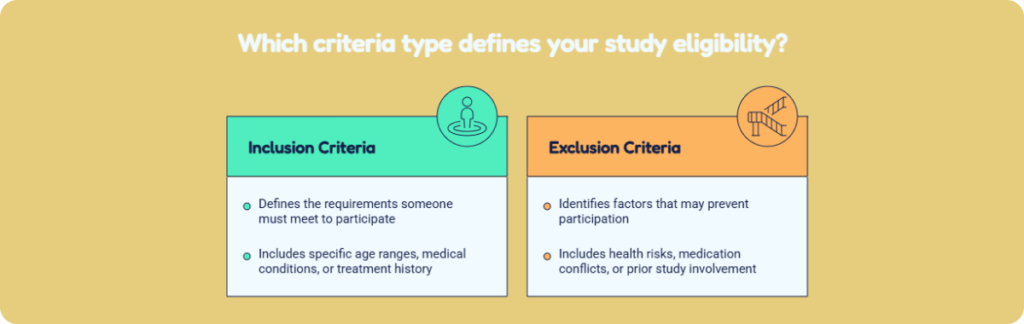
Researchers use two main categories when determining eligibility:
Inclusion Criteria
Inclusion criteria are the requirements someone must meet to participate.
Examples may include:
- Being within a specific age range.
- Having a certain medical condition.
- Meeting previous treatment requirements.
Exclusion Criteria
Exclusion criteria identify factors that may prevent participation.
These may include:
- Certain health risks.
- Medication conflicts.
- Previous participation in similar studies.
These requirements exist because researchers need accurate results while protecting participants.
How to Participate in Clinical Trials: Step-by-Step Process
If you are exploring how to participate in clinical trials, the process usually follows these steps:
1. Find a Clinical Trial That Matches Your Situation
The first step is identifying a study that fits your health needs, interests, or eligibility.
People often find trials through:
- Research organizations.
- Healthcare providers.
- Clinical research sites.
- Online study databases.
When searching how to join a clinical trial, review the study purpose, location, duration, and participation requirements before contacting the research team.
2. Review Eligibility Requirements
After finding a possible study, review the criteria carefully.
The research team may ask about:
- Your health history.
- Current medications.
- Previous treatments.
- Medical records.
This step helps determine whether the study is appropriate for you.
3. Contact the Research Team
Next, you typically speak with a research coordinator or study team member.
They may explain:
- Why the study is being conducted.
- What participation involves.
- How long the study lasts.
- What visits or procedures are required.
This conversation is also your opportunity to ask questions.
4. Complete the Screening Process
Screening confirms whether you meet the study requirements.
Depending on the trial, screening may include:
- Medical history review.
- Physical examinations.
- Laboratory tests.
- Questionnaires.
- Diagnostic assessments.
The goal is not only to determine eligibility but also to reduce unnecessary risks.
5. Review Informed Consent Before Joining
Before participating, every potential participant receives information about the study through the consent process.
Quick Guide:
Informed consent in clinical research is the process of making sure participants understand a study’s purpose, procedures, possible risks, benefits, and their choices before agreeing to participate.
Consent is not a one-time conversation. Participants can continue asking questions throughout the study.
6. Complete Clinical Trial Enrollment
Once eligibility is confirmed and consent is provided, the research team completes enrollment.
At this stage, the participant officially joins the study and begins following the research protocol.
7. Participate in Study Visits and Follow-Up
During the study, participants may:
- Attend scheduled visits.
- Complete health assessments.
- Report symptoms.
- Use study treatments as instructed.
- Communicate with researchers.
Participation requirements vary depending on the type of clinical trial.
How Do Clinical Trials Work After Enrollment?
Understanding “How do clinical trials work” helps participants know what happens after joining.
Clinical trials follow a structured protocol that explains:
- The research question.
- Participant requirements.
- Treatment procedures.
- Data collection methods.
- Safety monitoring plans.
Researchers continuously review participant information to evaluate safety and effectiveness.
Understanding the 4 Phases of Clinical Trials
The 4 phases of clinical trials explain how treatments are studied from early testing to long-term monitoring.
| Phase | Purpose |
|---|---|
| Phase 1 | Evaluates safety, dosage, and possible side effects in a small group |
| Phase 2 | Studies effectiveness and continues safety evaluation |
| Phase 3 | Tests treatment effectiveness in larger groups of participants |
| Phase 4 | Monitors long-term safety after approval |
Questions to Ask Before Participating in Clinical Trials
Before joining a study, ask questions such as:
- Why is this clinical trial being conducted?
- What are the possible risks?
- What benefits may I receive?
- How long will participation last?
- How many visits are required?
- Are there costs or compensation?
- Can I leave the study later?
Taking time to ask questions helps you make a decision based on accurate information.
Understanding Patient Rights in Clinical Research
Participants have important protections throughout the research process. Before clinical trials begin, many studies involving human participants must undergo review by an Institutional Review Board (IRB). These independent committees evaluate research plans to help protect participants’ rights, safety, and well-being throughout the study.
Patient rights in clinical research include the right to receive information, protect personal health data, ask questions, and voluntarily decide whether to continue participation.
These rights typically include:
- The right to understand study details.
- The right to privacy and protection of personal information.
- The right to withdraw from a study at any time.
- The right to report concerns or ask questions.
- The right to receive safety information throughout the trial.
Ethical research depends on respecting every participant’s choices and ensuring their safety, dignity, and well-being remain a priority.
Why Diversity Matters in Clinical Trial Participation
Research findings become stronger when studies include participants from different backgrounds.
Diversity in clinical trials helps researchers understand how treatments may work across different populations.
Historically, some groups have been underrepresented in clinical research. Greater inclusion helps improve healthcare knowledge and ensures treatments are evaluated across broader communities.
Diversity also supports more accurate research outcomes because factors such as genetics, environment, and lifestyle can influence how people respond to treatments.
How Technology Is Changing Clinical Trial Participation
Technology is creating new ways for people to take part in clinical research. Many modern studies now use digital tools that reduce the need for frequent in-person visits and make participation more accessible.
These approaches may include:
- Virtual appointments with research teams
- Remote monitoring devices that collect health data
- Digital questionnaires for tracking participant information
- Electronic consent systems for reviewing study details
These technology-driven approaches are often part of decentralized clinical trials, where some or all study activities happen remotely instead of only at a traditional research site.
However, researchers must also address the challenges of decentralized clinical trials, such as ensuring reliable technology access, protecting participant data, maintaining effective communication, and providing support throughout the study.
By balancing innovation with participant needs, technology can help create more convenient and inclusive clinical research experiences.
Continue Your Clinical Research Education with I.A.M Research & Wellness
Understanding clinical trials starts with education. Learning how studies work, how participants are protected, and the role of research professionals helps individuals make informed decisions about clinical research.
I.A.M. Research & Wellness Foundation provides clinical research education resources to help communities understand the clinical research industry. Through programs like the Principal Investigator (PI) Foundation Course, individuals can gain insight into research leadership and clinical research responsibilities.
Those interested in promoting awareness and connecting communities with research education can explore the IAM Affiliate Ambassador Program. By increasing research knowledge, we help create informed communities and improve awareness of clinical trial opportunities.
Conclusion
Understanding how to participate in clinical trials allows individuals to make informed decisions about joining research studies. Clinical trial enrollment is a structured process that includes eligibility review, screening, informed consent, and ongoing communication with researchers.
Every clinical trial participant contributes valuable information that helps researchers develop safer and more effective healthcare solutions. By learning about the process, participant rights, and research expectations, individuals can approach clinical trials with confidence and awareness.
Frequently Asked Questions (FAQs)
How do I participate in a clinical trial?
You can participate by finding a suitable study, checking eligibility requirements, completing screening, and providing informed consent before enrollment.
Who can join a clinical trial?
Anyone who meets a study’s specific eligibility criteria may qualify. Requirements often include factors such as age, health history, medications, and medical conditions.
What is the best way to get into a clinical trial?
The best way is to search for relevant studies through research sites or healthcare providers, review eligibility requirements, and communicate with the research team.
What is clinical trial enrollment?
Clinical trial enrollment is the process of officially joining a research study after meeting eligibility criteria, completing screening, and agreeing to participate.
Why do many clinical trials fail?
Clinical trials may fail due to factors such as safety concerns, lack of effectiveness, funding challenges, or difficulty enrolling enough eligible participants.